

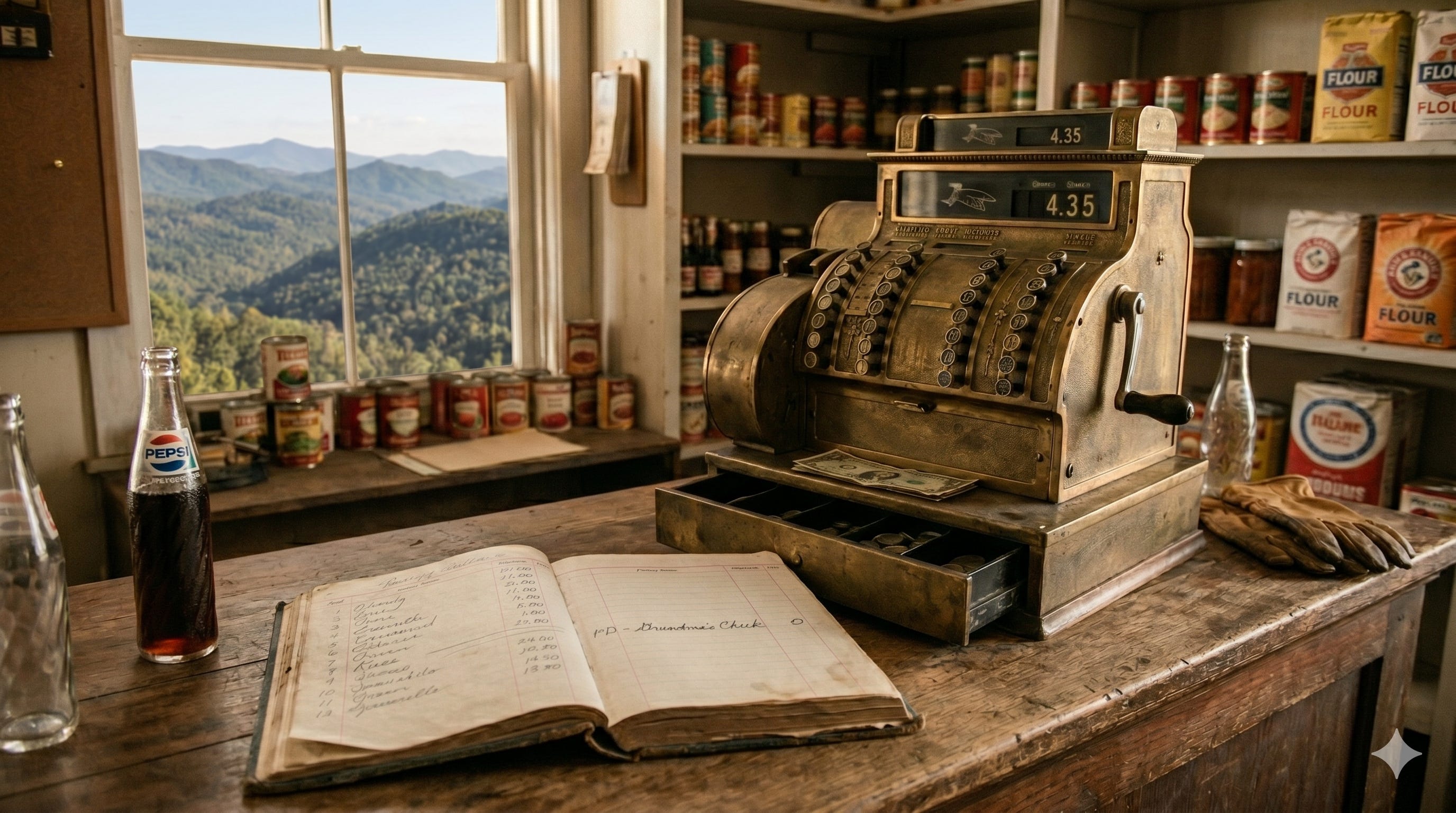
In the modern world, credit is a clinical, three-digit score controlled by a distant bank, an algorithm that doesn’t care if you need to eat or if you’re trying to stay warm through a hard winter. The cold truth of the modern economy is simple: if you don’t have capital, you don’t get credit. But forty years ago, along the winding curves of Route 72 in Clintwood, credit wasn’t calculated by a computer. It was kept in a paper ledger by men who knew your name, your family, and exactly when your grandma’s monthly check would arrive.
It’s 1977, a hot July morning in the small holler called Power’s Branch. I’ve had a breakfast of biscuits and gravy with a tall glass of milk, and my day has begun. I’ve had my Tonka trucks plowing through the coal pile, and now I have moved on to a large pile of dirt I dug up.
Grandpa comes to find me and asks if I want to go to the store with him. Of course I do. I jump into his old Ford pick-up and we head down the dirt road of the holler. It looks like a dust storm behind us on those hot days, but we are heading to Benny’s. Benny owned Vanover Supply, but no one called it that, it was just Benny’s. Once we reach the mouth of the holler, it’s a short two-mile drive around the curvy road leading to Darwin, where not only Benny’s is located but also Glenn’s Stanley Store.
Benny and Glenn both were very gracious and humble men. To the outside world, they were independent merchants running small-town storefronts. But to the families living along Route 72, they were something much larger: they were the quiet stabilizers of our daily lives.
Stepping through the door of Benny’s or Glenn’s was like stepping into a different climate altogether. The summer heat of Route 72 stayed outside, replaced by an interior that smelled distinctly of living: a rich, heavy blend of floor oil, coffee grounds, fresh sandwiches, and denim. Your boots immediately met weathered wooden floorboards, worn smooth in the walking paths and lightly dusted with clean sawdust to catch the mountain dirt.
The stores were packed from floor to ceiling with the needed items of our survival. At Benny’s, the walls held heavy work boots, thick leather gloves, and racks of rugged clothes built to withstand the thickets of Dickenson County. At Glenn’s, the shelves were lined with the staples that kept a household whole, blocks of sharp cheese, tubs of lard, and bags of flour. But the most important element wasn’t on the shelves. It was the immediate, genuine warmth of the smiles behind the counter. Benny and Glenn didn’t look at us as transactions or account numbers; they looked at us as neighbors, cousins and family. There was no rush, no corporate coldness, just a quiet, steady presence that let you know, before you even picked up a loaf of bread or a work shirt, that you were respected there.
But on this particular July morning, we hadn’t come to Benny’s or Glenn’s to add to the ledger. We were there to clear it. Grandma’s monthly check had arrived, and Grandpa was there to make good on the quiet promise that had kept our kitchen table full and our family clothed through the lean weeks. I watched as he stepped up to the counter, greeting Benny with a smile and a handshake. There was no paperwork mailed from a distant bank, just a worn paper ledger turned to our family’s page. Grandpa pulled the cash from his pocket, money earned through hard work and stretched by sacrifice, and paid the tab down to zero.
With the business concluded, the transaction shifted from necessity to a reward. Grandpa looked down at me, then over to the heavy iron chest cooler humming in the corner. “Go get you one, Sean,” he’d say. I’d slide back the heavy lid, reaching down to pull out a real Pepsi, the kind in the thick glass bottle. To this day, I swear soda tasted better out of those glass bottles. Standing there on the sawdust covered floors, popping the cap off and taking that first ice-cold sting of a real Pepsi. I didn’t understand the macro-economics of Appalachian survival. I just knew that we were squared up with the world, my grandpa’s word was golden, and for a kid in Power’s Branch, life was good.
The pride Grandpa felt when he handed that cash across the counter to Glenn or Benny went far deeper than the simple relief of being out of debt. In a community like Clintwood, clearing your tab was a vital act of family responsibility. It was a closed loop of survival. Benny and Glenn weren’t banks with endless reserves; they were independent merchants absorbing the financial weight of an entire area on a few sheets of paper. When Grandpa paid our bill down to zero, he wasn’t just squaring our family up with the world, he was ensuring that the ledger had room to carry the next family down the road whose kids needed shoes or whose shelves were bare two weeks before the next check.
This mutual rhythm created a profound, long-term stability that macro-economics completely fails to measure. By extending trust, the storekeepers kept families whole during their leanest months; by honoring that trust the moment the check arrived, the community kept the storekeepers alive. It was a decentralized, human-powered safety net that sustained Route 72 for generations. The long-term impact wasn’t found in a bank’s profit margins, but in the sheer resilience of a people who refused to let poverty strip them or their neighbors of their dignity.
We drove back up the dirt road into Power’s Branch that afternoon with a clean slate, the dust billowing behind the tailgate of the old Ford. I had a sticky, empty Pepsi bottle in my hand, and Grandpa had something much lighter: a cleared conscience. Looking back, those weekly and monthly interactions across the worn counters at Glenn’s and Benny’s weren’t just transactions; they were the quiet threads holding our community together.
Today, the country stores have largely given way to regional supermarkets and digital payment networks. We have traded the paper ledger for the immediate convenience of the swipe and the tap. But as we navigate an economy driven by faceless algorithms and rigid credit metrics, we lose the very thing that kept us whole: neighborly trust. Glenn and Benny didn’t just sell us food and clothes; they invested in our survival, proving that a community’s truest wealth is never found in a bank’s profit margins, but in the care we extend to one another when the weeks run lean. In the end, it wasn’t the money that saved us, but the quiet grace of good hearted men that refused to let us go hungry.
That's a great memory and understanding of the way it worked back then. I remember going to Benny's with Mamaw when we visited. I still stop sometimes for memories sake.